 Dads Framework
Permissions in Postgres & SpiceDB
On this page
Dads splits authorization into two layers: a database-free permission model (@dads-framework/access) and an execution engine (@dads-framework/postgres-access for PostgreSQL, or @dads-framework/authorization for SpiceDB).
Your domains import only @dads-framework/access. Business logic and unit tests stay database-free, while production checks execute inside PostgreSQL transactions.
1. Declare entities, roles, and inheritance
Define typed entity handles and compose permissions with access() and through() (apps/workbench/src/access.ts):
export const workbenchUser = entityHandle({
  wireName: "user",
  idSchema: resourceId,
});
const workspaceEntity = entityHandle({
  wireName: "workspace",
  idSchema: resourceId,
  kind: "scope",
});
const taskEntity = entityHandle({
  wireName: "task",
  idSchema: resourceId,
  kind: "record",
});
const userDefinition = access(workbenchUser, {
  roles: {},
  permissions: () => ({}),
});
export const workbenchWorkspace = access(workspaceEntity, {
  roles: { owner: workbenchUser, member: workbenchUser },
  permissions: ({ owner, member }) => ({
    view: [asPermissionTerm([owner, member])],
    manage: [owner],
  }),
});
export const workbenchTask = access(taskEntity, {
  roles: { workspace: workspaceEntity },
  permissions: ({ workspace }) => ({
    view: [through(workspace, workbenchWorkspace.permissions.view)],
    manage: [through(workspace, workbenchWorkspace.permissions.manage)],
  }),
});

/** Task state, including claims, never grants independent access. */
export const workbenchAccessModel = accessModel([
  userDefinition,
  workbenchWorkspace,
  workbenchTask,
]);
Because workbenchTask inherits through workspace, revoking a user's workspace membership immediately revokes access to every task inside that workspace.
2. Guard writes inside a serializable Postgres transaction
Install the standalone packages in any PostgreSQL project (Node.js 22 or later):
npm install @dads-framework/access @dads-framework/postgres @dads-framework/postgres-access zod
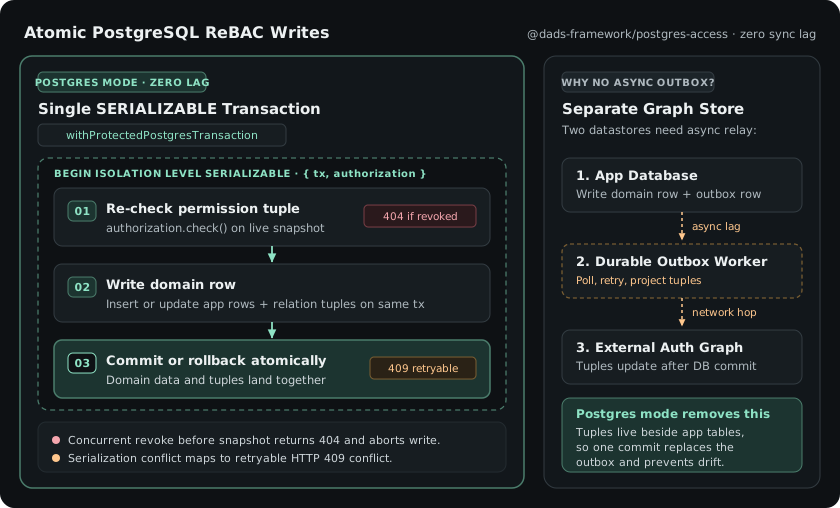
When an operation mutates data, re-check the permission inside the same serializable transaction as the write using withProtectedPostgresTransaction (assembly/protected-write.ts):
export function createProtectedWrite(
  database: DrizzleHandle,
  authorization: PostgresAuthorization,
): WriteWithPermission {
  return async ({ subject, permission, resourceId }, write) => {
    try {
      return await withProtectedPostgresTransaction(
        { database, authorization },
        async ({ tx, authorization: scoped }) => {
          const allowed = await scoped.check({
            subject,
            permission: permission.permissionName,
            resource: { type: permission.entityWireName, id: resourceId },
          });
          if (!allowed)
            throw notFound("RESOURCE_NOT_FOUND", "Resource not found");
          return write(tx, scoped);
        },
      );
    } catch (fault) {
      if (fault instanceof PostgresSerializationConflict) {
        throw conflict(
          fault.code,
          "The transaction could not finish. Retry the request.",
          { retryable: true },
        );
      }
      throw fault;
    }
  };
}
Both the permission check and the business write share one PostgreSQL transaction snapshot. Removing a member and deleting their business rows commit or roll back together, with zero authorization outbox lag.
3. Export permission guards and attach them to routes
Export named access handles from domains/<feature>/access/index.ts so routes stay declarative and share one policy definition (domains/notes/access/index.ts):
import { fromParam, type PermissionAccess } from "@dads-framework/http";
import { tenantAccess } from "../../../libraries/app-runtime/index.js";

export const notesPermission = tenantAccess.tenant.permissions.view;

/** Notes are visible only inside a tenant the account can view. */
export const notesAccess: PermissionAccess = {
  kind: "permission",
  resourceType: notesPermission.entityWireName,
  permission: notesPermission.permissionName,
  resourceId: fromParam("tenantId"),
};
Route enforcement runs in strict order:
- Missing or invalid session returns
401 Unauthorized. - Missing relationship returns
404 Not Foundbefore body or query validation runs, preventing existence leaks. - Only authorized requests reach Zod validation and your handler.
4. Test grants, denials, and revocations without a database
Use @dads-framework/access/testing to prove both allowed calls and fail-closed denials in fast unit tests. Every protected route should include at least one test verifying that a caller without a relationship receives 404.
5. Emit SpiceDB .zed from the same model
If you already operate SpiceDB or outgrow a single PostgreSQL primary later, call emitZed(model) from @dads-framework/access to generate SpiceDB schema text directly from the same TypeScript model, then swap PostgresAuthorization for @dads-framework/authorization in assembly/services.ts. Domain files, route guards, and tests stay unchanged.
Related references
@dads-framework/accessfor combinators (through,both,excluding),grantable, andemitZed(model)@dads-framework/postgres-accessfor standalone setup, prepared point checks, lookup reuse, and benchmarks- ADR 0001: Transactional PostgreSQL ReBAC