# Permissions in Postgres & SpiceDB
Dads splits authorization into two layers: a database-free permission model ([`@dads-framework/access`](https://dadsframework.dev/docs/package-access)) and an execution engine ([`@dads-framework/postgres-access`](https://dadsframework.dev/docs/package-postgres-access) for PostgreSQL, or [`@dads-framework/authorization`](https://dadsframework.dev/docs/package-authorization) for SpiceDB).
Your domains import only `@dads-framework/access`. Business logic and unit tests stay database-free, while production checks execute inside PostgreSQL transactions.
## 1\. Declare entities, roles, and inheritance
Define typed entity handles and compose permissions with `access()` and `through()` (`apps/workbench/src/access.ts`):
```ts
export const workbenchUser = entityHandle({
wireName: "user",
idSchema: resourceId,
});
const workspaceEntity = entityHandle({
wireName: "workspace",
idSchema: resourceId,
kind: "scope",
});
const taskEntity = entityHandle({
wireName: "task",
idSchema: resourceId,
kind: "record",
});
const userDefinition = access(workbenchUser, {
roles: {},
permissions: () => ({}),
});
export const workbenchWorkspace = access(workspaceEntity, {
roles: { owner: workbenchUser, member: workbenchUser },
permissions: ({ owner, member }) => ({
view: [asPermissionTerm([owner, member])],
manage: [owner],
}),
});
export const workbenchTask = access(taskEntity, {
roles: { workspace: workspaceEntity },
permissions: ({ workspace }) => ({
view: [through(workspace, workbenchWorkspace.permissions.view)],
manage: [through(workspace, workbenchWorkspace.permissions.manage)],
}),
});
/** Task state, including claims, never grants independent access. */
export const workbenchAccessModel = accessModel([
userDefinition,
workbenchWorkspace,
workbenchTask,
]);
```
Because `workbenchTask` inherits through `workspace`, revoking a user's workspace membership immediately revokes access to every task inside that workspace.
## 2\. Guard writes inside a serializable Postgres transaction
Install the standalone packages in any PostgreSQL project (Node.js 22 or later):
```sh
npm install @dads-framework/access @dads-framework/postgres @dads-framework/postgres-access zod
```
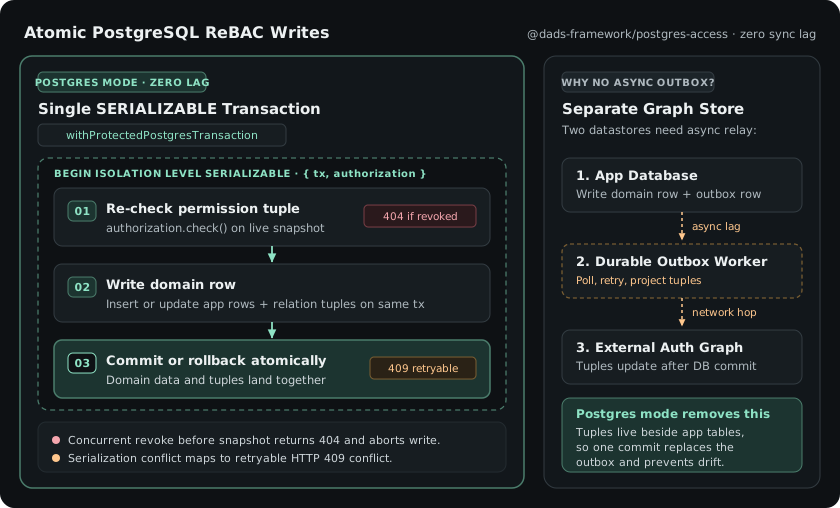
When an operation mutates data, re-check the permission inside the same serializable transaction as the write using `withProtectedPostgresTransaction` (`assembly/protected-write.ts`):
```ts
export function createProtectedWrite(
database: DrizzleHandle,
authorization: PostgresAuthorization,
): WriteWithPermission {
return async ({ subject, permission, resourceId }, write) => {
try {
return await withProtectedPostgresTransaction(
{ database, authorization },
async ({ tx, authorization: scoped }) => {
const allowed = await scoped.check({
subject,
permission: permission.permissionName,
resource: { type: permission.entityWireName, id: resourceId },
});
if (!allowed)
throw notFound("RESOURCE_NOT_FOUND", "Resource not found");
return write(tx, scoped);
},
);
} catch (fault) {
if (fault instanceof PostgresSerializationConflict) {
throw conflict(
fault.code,
"The transaction could not finish. Retry the request.",
{ retryable: true },
);
}
throw fault;
}
};
}
```
Both the permission check and the business write share one PostgreSQL transaction snapshot. Removing a member and deleting their business rows commit or roll back together, with zero authorization outbox lag.
## 3\. Export permission guards and attach them to routes
Export named access handles from `domains//access/index.ts` so routes stay declarative and share one policy definition (`domains/notes/access/index.ts`):
```ts
import { fromParam, type PermissionAccess } from "@dads-framework/http";
import { tenantAccess } from "../../../libraries/app-runtime/index.js";
export const notesPermission = tenantAccess.tenant.permissions.view;
/** Notes are visible only inside a tenant the account can view. */
export const notesAccess: PermissionAccess = {
kind: "permission",
resourceType: notesPermission.entityWireName,
permission: notesPermission.permissionName,
resourceId: fromParam("tenantId"),
};
```
Route enforcement runs in strict order:
1. Missing or invalid session returns **`401 Unauthorized`**.
2. Missing relationship returns **`404 Not Found`** before body or query validation runs, preventing existence leaks.
3. Only authorized requests reach Zod validation and your handler.
## 4\. Test grants, denials, and revocations without a database
Use `@dads-framework/access/testing` to prove both allowed calls and fail-closed denials in fast unit tests. Every protected route should include at least one test verifying that a caller without a relationship receives `404`.
## 5\. Emit SpiceDB `.zed` from the same model
If you already operate SpiceDB or outgrow a single PostgreSQL primary later, call `emitZed(model)` from `@dads-framework/access` to generate SpiceDB schema text directly from the same TypeScript model, then swap `PostgresAuthorization` for [`@dads-framework/authorization`](https://dadsframework.dev/docs/package-authorization) in `assembly/services.ts`. Domain files, route guards, and tests stay unchanged.
## Related references
* [`@dads-framework/access`](https://dadsframework.dev/docs/package-access) for combinators (`through`, `both`, `excluding`), `grantable`, and `emitZed(model)`
* [`@dads-framework/postgres-access`](https://dadsframework.dev/docs/package-postgres-access) for standalone setup, prepared point checks, lookup reuse, and benchmarks
* [ADR 0001: Transactional PostgreSQL ReBAC](https://github.com/brytoncooper/dads-framework/blob/main/docs/decisions/0001-transactional-postgres-rebac.md)
Canonical page: