# Multi-API Composition & CI Gates
Dads separates **which routes exist on an HTTP process** from **where domain code lives**, then checks import boundaries and code rules mechanically in CI.
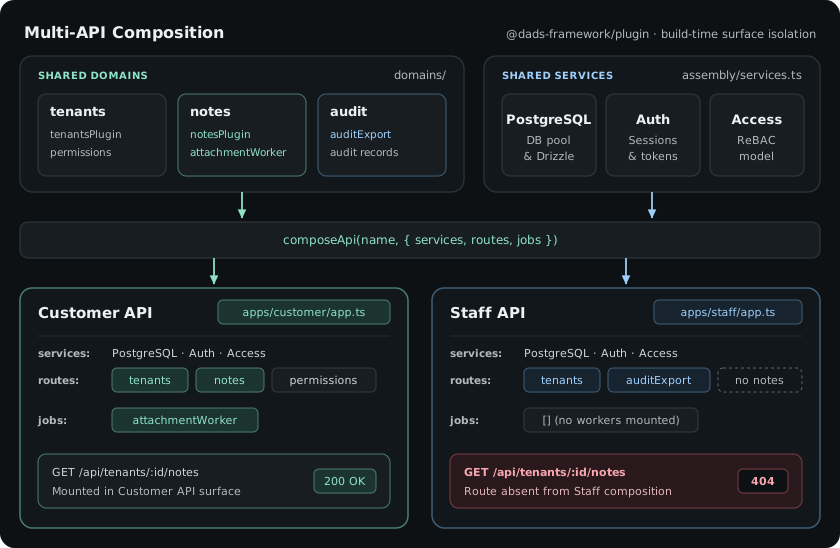
## 1\. Compose separate API entrypoints
Each file under `apps//app.ts` is a short manifest calling `composeApi` from [`@dads-framework/plugin`](https://dadsframework.dev/docs/package-plugin). It selects the domain plugins and background jobs that entrypoint exposes (`apps/customer/app.ts`):
```ts
export function customerApp(provider: ServiceProvider) {
return composeApi("customer", {
services: [provider, starterAccess],
routes: [
tenantsPlugin,
tenantPermissionsPlugin,
notesPlugin,
// dad:add domains
],
jobs: [notesAttachmentWorker],
});
}
```
`apps/staff/app.ts` mounts internal routes (such as audit exports) and omits `notesPlugin` completely:
```ts
export function staffApp(provider: ServiceProvider) {
return composeApi("staff", {
services: [provider, starterAccess],
routes: [
tenantsPlugin,
tenantAuditExportPlugin,
// dad:add domains
],
jobs: [],
});
}
```
Customer routes are not hidden behind a feature flag on the staff server; they are never registered on that Fastify instance.
## 2\. Enforce domain boundaries with `dads.project.json`
`dads.project.json` declares your packages and the three boundary tiers:
```json
{
"domainBoundaries": {
"domains": ["src/domains/*", "domains/*"],
"libraries": ["libraries/*"],
"composition": ["src/composition", "apps/*", "assembly"]
}
}
```
The import rules enforced by `npx dad check boundaries`:
* **`domains/*`** can import framework packages and `libraries/*`. A domain can never import another domain's tables, routes, or internals.
* **`libraries/*`** hold shared runtime tokens and base entity handles (such as `libraries/app-runtime/index.ts`) and import framework packages only.
* **`apps/*` and `assembly/`** sit in the composition tier and wire domains together with real infrastructure (PostgreSQL, auth, mail, object storage).
When one domain needs data from another domain, define a narrow TypeScript port and wire the implementation in `assembly/services.ts` instead of importing across domains.
```sh
npx dad check boundaries
```
## 3\. Run Doctor and changed-file verification in CI
Every starter includes `npm run verify` and the `@dads-framework/toolbox` CLI for local and CI gates:
| Command | What it checks |
| :-- | :-- |
| `npm run verify` | Runs boundary checks, TypeScript type-checking, web build, and tests |
| `npx dad check boundaries` | Fails if any file crosses a domain boundary or undeclared dependency |
| `npx dad doctor --gate` | Checks repo-wide rules: zero `any`, zero unsafe casts, routes with `access`, denial test coverage, and source budgets |
| `npx dad verify --changed --json` | Runs focused checks for files touched in the current branch |
> **Coding agents and CI:** Because boundaries, `access` declarations, and denial tests are verified by `dad check boundaries` and `dad doctor --gate`, broken imports or unguarded endpoints fail before code review.
## 4\. Deploy outside development
Every generated starter ships with a `DEPLOY.md` and production scripts in `package.json`:
1. Install dependencies from the committed lockfile with `npm ci` and run `npm run verify`.
2. Set `DATABASE_URL`, `DADS_IDENTITY_SECRET`, and `DADS_BASE_URL` in your runtime secret store.
3. Run database migrations once before booting new API instances:
```sh
npm run migrate
```
4. Start each API process by selecting `DADS_API=customer` or `DADS_API=staff`:
```sh
NODE_ENV=production DADS_API=customer HOST=127.0.0.1 PORT=3000 npm run start:api
```
5. Check liveness against `/api/health`:
```sh
curl -fsS http://127.0.0.1:3000/api/health
```
A healthy process responds with HTTP `200` and `{ "data": { "status": "ok" } }`.
## Related references
* [`@dads-framework/toolbox`](https://dadsframework.dev/docs/package-toolbox) for all CLI commands and JSON output schemas
* [`@dads-framework/plugin`](https://dadsframework.dev/docs/package-plugin) for `composeApi`, `defineService`, and `providePlugin`
* [Architecture decisions](https://github.com/brytoncooper/dads-framework/blob/main/docs/decisions/README.md)
Canonical page: